Courtenay Katherine

DAY 4: Arequipa, Peru, July 3, 2025

DAY 4: Arequipa, Peru, July 3, 2025

On our last day in Arequipa, we walked back toward the historical center to finish exploring the exhibitions we’d started earlier in the week. Just before reaching the plaza, we spotted Librería Fabla Salvaje, a small independent bookstore on Calle Jerusalén. Knox talked with the staff and picked up several rare Spanish-language books they recommended. The shop is focused on promoting literature from southern Peru and supports independent publishing through events, workshops, and local partnerships.

We continued to Galería de Arte – Centro Cultural UNSA, the gallery we had visited briefly at night. This time, seeing it in daylight gave us a chance to appreciate the work more fully. The museum features regional and contemporary pieces, all thoughtfully arranged in a stunningly beautiful, quiet space.

From there, we walked to Fundo El Fierro, a historic artisan market housed in a former colonial estate. Run by the Asociación de Artesanos Productores Fundo El Fierro, the market supports over 60 artisans from across Peru. Their mission is to preserve traditional crafts, handwoven textiles, alpaca wool garments, silver jewelry, and a few ceramics while providing economic opportunities for local makers. We didn’t find anything to take home, but it was worth the visit to see the craftsmanship and chat with the vendors.

Dinner was at Zig Zag, located in a restored colonial building with high sillar stone ceilings and a metal spiral staircase attributed to Eiffel. My trout arrived seared on hot volcanic stone, and although Knox went for a different dish, we both were handed the restaurant’s signature bibs, apparently the tradition and rather silly, but practical in the end. We lucked into the only upstairs window seat, where we watched the evening foot traffic below. By the end of the meal, the rush of folks heading home had slowed to just a few quiet stragglers. The restaurant is top-notch—excellent service, standout food and wine, and a well-balanced menu blending European and Peruvian flavors.

Arequipa isn’t just a great city to visit. There’s a lot to explore beyond the center, and we’re already thinking about coming back for a longer stay. The coast is just 90 minutes away, with beaches like Playa Catarindo near Mollendo offering a change of pace. Inland, there’s Colca Canyon for trekking and condor spotting, the Salinas and Aguada Blanca National Reserve for wildlife and salt flats, and the Sillar Route with its active quarries and canyon walls carved from volcanic stone. Plenty of reasons to return.

Day 4 photos HERE.

DAY 4: Arequipa, Peru, July 3, 2025 Read More »

DAY 3: Arequipa, Peru, July 2, 2025

 DAY 3: Arequipa, Peru, July 2, 2025

We decided to meet up with our guide again, this time to focus on the city itself rather than heading out to the surrounding sites. Plaza de Armas has been the heart of Arequipa since the 1540s, designed in the classic colonial grid layout. It remains lively today, with broad stone walkways, manicured gardens, and three arcaded sides enclosing the square. The Cathedral dominates the entire north end—just as striking by day as it is at night. In the sunlight, its white sillar stone looks crisp and pristine, but after dark, it glows with a soft pink hue. Unfortunately, we learned that seeing the inside of the cathedral is not possible, as it is closed to the public.

At the center of the plaza is a bronze fountain topped by a small figure called the “Tuturutu.” According to legend, he was a messenger left behind by the Inca to watch over a tambo and alert others to news using a horn; the name comes from the sound it made: tuturutúúú. Eventually, he was said to have frozen in place, horn in hand, facing the sun. But our guide offered another more modern version: the horn was used not for royal messages but to warn townspeople of pickpockets, minstrels, or other street action — a kind of early public service announcement from the plaza.

We crossed to the nearby Templo La Compañía de Jesús. The entire façade is densely covered with carved stone — vines, birds, angels —every inch used. Inside is quieter, with side altars along the walls and a large gold altar at the front. Our guide said the Jesuit church dates to the late 1500s but had been rebuilt after a major earthquake in 1687 and parts of it again restored after subsequent earthquakes.

The most striking part was the Capilla de San Ignacio, a side chapel with a painted dome and walls covered in bright, tropical murals picturing parrots, palm trees, monkeys…odd for a religious setting. The paintings are over 300 years old, have never been restored and are likely connected to Jesuit missions in the rainforest. Truly incredible.

From the historic center, we walked about ten minutes to reach Mercado San Camilo, Arequipa’s main market. The streets on the way were packed with cars bumper to bumper and vendors covering the sidewalks.

The market covers at least three or four city blocks. It is much like other markets we have visited in South America, but much bigger. Crowds moved through relatively wide aisles while vendors shouted prices and advertised their wares. There were stalls for corn, citrus, every sort of vegetable imaginable, stacks of corn, dried beans, coca leaves, dried medicinal herbs, mounds of  freshly baked bread, cheeses, olives, etc. Our guide explained some of the regional produce, especially the unfamiliar varieties of potatoes and fruit, many of them grown in the surrounding valleys. Near the food stalls, rows of women sat shoulder to shoulder at small counters eating breakfast. Our guide said it’s common for women to come early to shop, then stay and catch up with friends over a meal.

The fish section was remarkable with long rows of counters stacked with large fish like corvina, mero, and bonito, all laid out on ice or being gutted on the spot. Also, our guide pointed out a big pile of what he said was caviar, known as Cau Cau, which is definitely fish eggs and something resembling caviar, though not the luxury sturgeon kind. Comng from Mendoza, where fresh fish isn’t common, the sheer volume and size of the fish on display was striking.

Upstairs in the textile section, it was quiet. A handful of vendors sat among stacked stalls of textiles and alpaca goods. From that upper level, we had a clear view of the floor below. From there, we could look down on the main floor and see just how large the market actually is.

Our guide then led us to explore several tambos, centuries-old communal buildings originally designed to house merchants, travelers, and their goods. These structures, dating back as far as the 17th and 18th centuries, are built from sillar, and today, many have been repurposed into regular apartments. One standout in our visit was Tambo de Bronce. Once a hub for commerce and later a military barracks during the War of the Pacific, it was restored after the 2001 earthquake and now serves as a cultural venue. With its stone façade, vaulted ceilings, and graceful arches, it stands as a clear example of Arequipa’s historic, enduring architecture.

Next, we headed to Museo Santuarios Andinos, home to Juanita, the frozen Inca maiden sacrificed over 500 years ago, but the wait for a tour (required) was too long, so we decided to save it for another day.

On the way back to the car, our guide stopped and invited us to check out a beautiful leather shop, Pedro P. Díaz Cueros, where we each picked out a classic wallet.  Dating back to 1923, the shop specializes in high-quality leather goods. Really fine craftmanship. It was hard to choose!

We wanted to see some of the nicer neighborhoods in Arequipa because by this point, given the amazing weather, the people we had met, and the vibe of the city in general, we began seriously thinking this might be a perfect place to spend winters in the future. Our guide happily gave us a tour of two sections of the city, both within walking distance of the historic district: Cayma and Yanahuara.

We drove out of the center maybe ten minutes before hitting some traffic on the main commercial street of Yanahuara, quite lovely with a median full of pine trees and planted pots. We had been here the day before to see the city from the famous overlook. When you turn off the main drag into some of the quieter surrounding streets, you find beautiful townhouses and apartments with some houses sprinkled in, plus flower-filled balconies and quiet courtyards, with a blend of colonial architecture and modern style. Elegant, walkable, and full of character.

Cayma felt like a peaceful retreat, just outside the city center and close to the chacras and open farmland. We drove through quiet, residential neighborhoods higher up, with views of the city and a strong family-oriented vibe. Our guide lives there, and it’s easy to see why. Cayma offers a quiet, family-friendly atmosphere with lots of fresh air, wide streets, and scenic views, all while staying close enough to the city for convenience. You can walk to the historic center from there, but having a car would be more practical.

Our guide dropped us in the center mid-afternoon, where we wandered a bit, found a rooftop spot for a lovely late-day meal before heading back to the hotel.

Day 3 photos HERE.

DAY 3: Arequipa, Peru, July 2, 2025 Read More »

Day 2: Arequipa, Peru, July 1, 2025

DAY 2: Arequipa, Peru, July 1, 2025

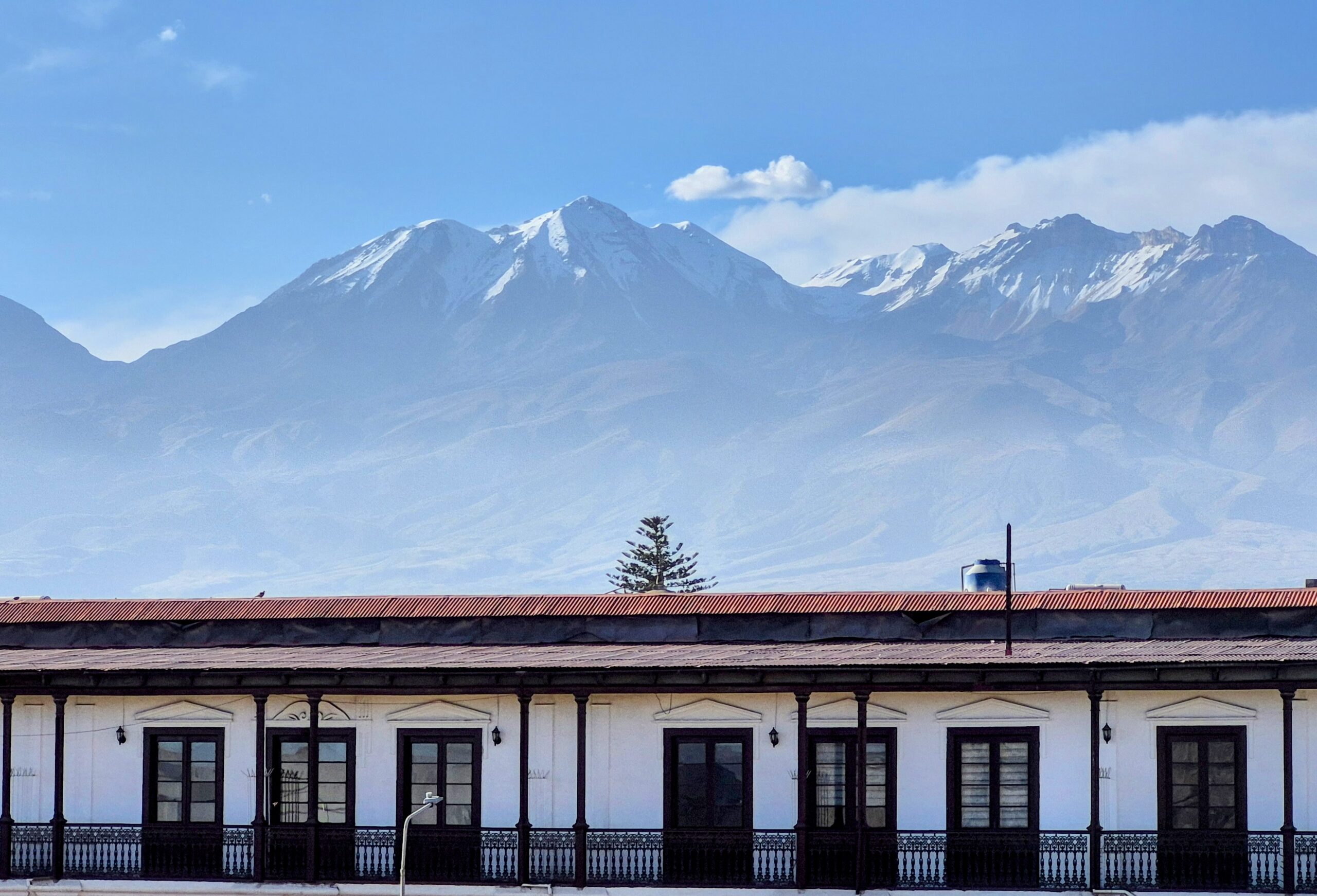
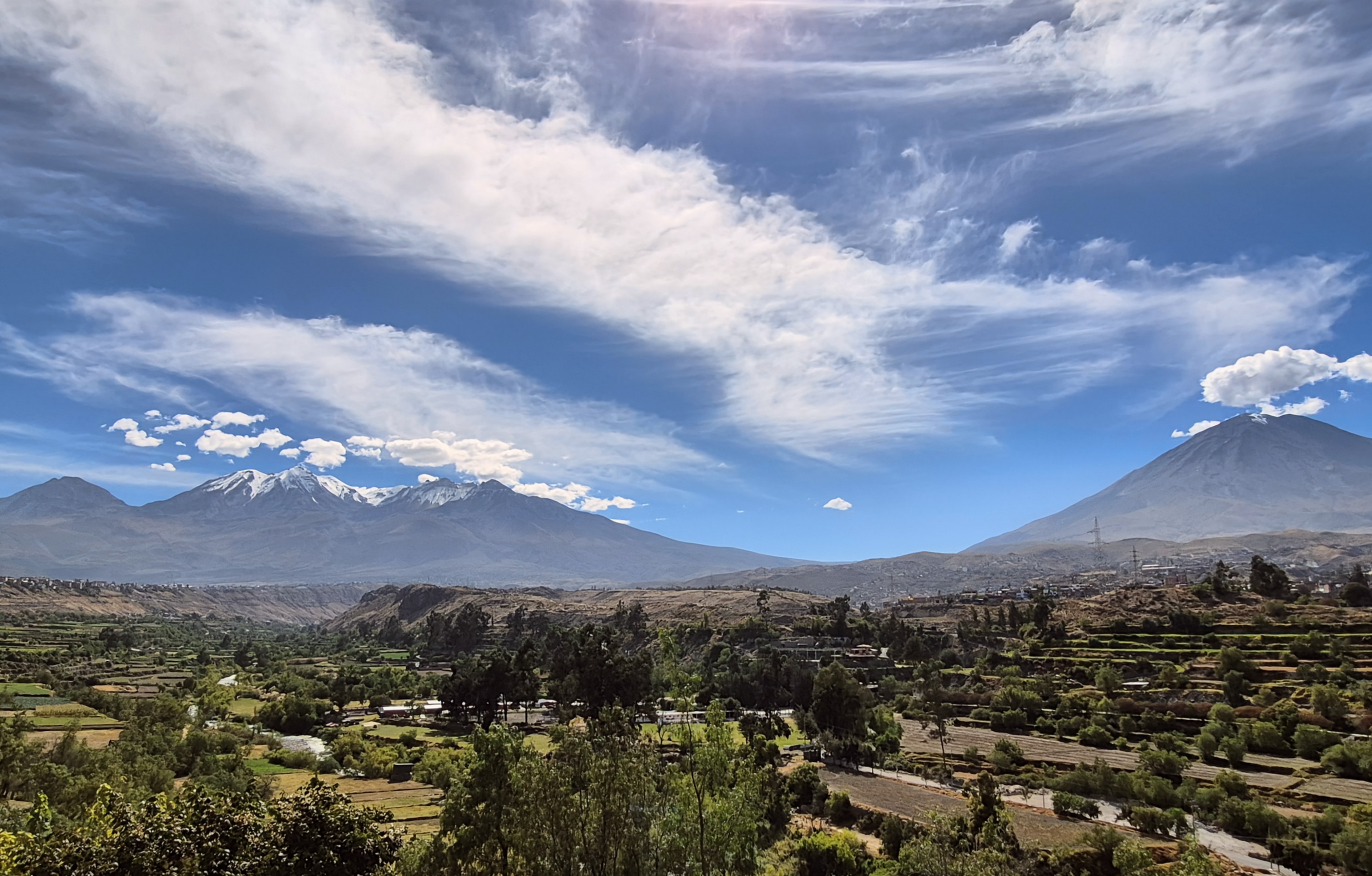
We began the day at Mirador de Carmen Alto with our guide. From the viewpoint, you can see how the city and valley fit together—the green terraces of the Chilina Valley below, still farmed after centuries, with the Río Chili running through them. Off in the distance, three volcanoes line the horizon: Chachani, the tallest at 19,872 feet, sits to the west and is often snow-capped. Misti, in the center, rises to 19,101 feet with its perfect cone and long history of eruptions. And Pichu Pichu, at 18,583 feet, stretches out like a man lying on his back with arms folded; locals point it out like an old friend. All three are considered sacred in the Andean tradition, honored as apus, or protective spirits.

Next, we headed to Mirador de Yanahuara in the Yanahuara district, a short drive from the historic center. It’s an expansive spot that offers sweeping views of the city and volcanoes through sillar stone arches. The area, along with nearby Cayma, has tree-lined residential streets and bustling commercial pockets.

In Quechua, “yana” means black, and “wara” means undergarment or loincloth. So this charming colonial district translates quite literally as “black underwear.” Historians trace the name to the Yanahuara people, Inca-era settlers relocated to the area, possibly referencing the color of their garments. One version of the story says that when women crossed the Río Chili, the dark volcanic silt stained their white undergarments, leaving them “yana wara.” Ha, ha!

The third viewpoint of the day was Mirador de Sachaca, where we climbed the five-story tower (it feels taller) for open views in every direction. From the top, the city stretches across the valley: green fields, scattered buildings, and the same three volcanoes in the distance, a little hazier now.

Arequipa’s nickname, El León del Sur, “The Lion of the South,” comes from its long history of doing things its own way, as our guide put it. In 1883, during the War of the Pacific when Lima was occupied, Arequipa became Peru’s provisional capital and even issued its own passports. People still joke about the “República Independiente de Arequipa,” and the pride locals have in their city is unmistakable. We saw it in everyone we met.

Next was Puente de Fierro, the 19th-century railway bridge that locals still like to claim was designed by Eiffel (it wasn’t, but the myth sticks). Built in 1871 as part of the line connecting Arequipa to Puno, it was engineered in the U.S. with then-cutting-edge iron trusses. It’s mostly pedestrian now. We walked across and looked down at the valley, where farmland stretches out below. Green chacras, small agricultural plots, still thrive in the middle of the sprawling city, with the Río Chili winding through it all, framed by the volcanoes above. (Same chacras, same meaning, as in our town’s name, Chacras de Coria.)

Mundo Alpaca was our last stop of the day. Envisioned by Frank W. Michell, a pioneer in Peru’s alpaca industry and the founder of Michell & Cia, the textile company behind the initiative, the Mundo Alpaca cultural center in Arequipa was established in 2005, building on Michell & Cia’s legacy that dates back to 1947, when the company opened Peru’s first alpaca combing and spinning plant.

I was skeptical because we’ve seen plenty of these displays across the Andes, but this one stood out. The layout is thoughtful, and the animals seem well cared for. The fiber sorting and weaving demos were familiar, but the museum surprised us: clear, detailed, and professionally done. It walks you through alpaca wool production, from raw fleece to finished yarn, with strong visual explanations. The unmistakable smell of alpaca wool hits you as soon as you walk in—warm, slightly earthy, and hanging in the air. The garments were exceptional, easily the best we’ve come across. I bought a sweater; Knox picked out some socks. Most of the company’s output is exported as yarn, but the boutique had some beautiful, finished pieces. Our guide finally clarified baby alpaca: it’s the very first shearing of a young alpaca, done only once, around age four.

After a late lunch of ceviche at the hotel (what else?) and a nap, we headed down the hill to the historic center in time for our reservation at Chicha to celebrate my birthday (we’d celebrated Knox’s in Lima the week before). With a bit of extra time, we stopped at Galería de Arte – Centro Cultural UNSA, tucked behind the Santa Catalina Monastery on a quiet stretch of Calle Ugarte. We didn’t expect much, just a quick pass-through, but the space opened into something more nuanced. It holds a rotating collection of contemporary Peruvian art, thoughtfully curated: bold pieces set in colonial rooms of white sillar, with high ceilings, arched doorways, and a soft-lit central courtyard. The galleries are compact but well arranged. Most works were contemporary: acrylics exploring light and color, along with striking oils and watercolors. We didn’t have time to see everything, so planned to return the next day and take our time.

Chicha por Gaston Acurio is a quiet space, low-lit, unassuming, and tucked into a restored building that doesn’t try too hard. We went with the fixed menu and wine pairings, which felt right for the occasion. It was my birthday (we’d celebrated Knox’s the week before in Lima), and the staff marked it with a song—first in English, then in Spanish. Not a surprise, but appreciated.

Two dishes stood out, both firsts for me. The cuy came shredded and seasoned, wrapped in a soft corn tortilla with a mild pepper sauce. (Cuy are essentially wild guinea pigs, considered a delicacy in Peru and now farmed for eating. We used to have tons of them in our yard at home until the dog drove them out.) The llama carpaccio was sliced thin and paired with something sharp, maybe citrus or mustard, that kept it from feeling heavy. The wines were from Argentina, Chile, and Peru, with an excellent Italian Sangiovese to finish.

After a long day, we took an Uber back to the hotel. We’d been debating whether to spend our last day on a trek outside the city but decided there was still more of Arequipa we wanted to explore. We figured the farther-afar spots like Colca Canyon, and  the Salinas Salt Flats, could wait for another trip.

DAY 2 Photos HERE.

Day 2: Arequipa, Peru, July 1, 2025 Read More »

Day 1: Arequipa, Peru, June 30, 2025

Arequipa, Peru, June 30, 2025

We arrived in Arequipa mid-afternoon and the view from the air revealed the desert terrain and enormous volcanoes around the city. It was larger than we expected, with around 1.8 million people and a sprawling layout with whole neighborhoods perched in the shadows of the three major volcanoes — Chachani, Misti, and Pichu Pichu.

The Wyndham Costa del Sol, Arequipa is located in the quiet, green Selva Alegre neighborhood, about a 15-minute walk from the city’s historic center. The property is surrounded by spacious, well-kept gardens, where three alpacas graze. Juanita, a 150-year-old tortoise and long-time resident of the grounds, has been part of the landscape longer than the hotel itself.

After a nap, we headed down into the historical district to find a place for dinner. Walking the streets is a completely different experience than most other South American cities we have visited. It has a European feel—narrow, hilly and sometimes winding, walkable, and full of historic architecture. We wound down the lively streets filled with venders and folks out shopping and dining, and came to the Plaza de Armas. The square is large, active, and felt very safe, with many people out enjoying the evening. Arequipa’s main square dates back to 1540 during the Spanish colonial period. Following a major earthquake in 1582, the city was largely rebuilt using sillar stone.

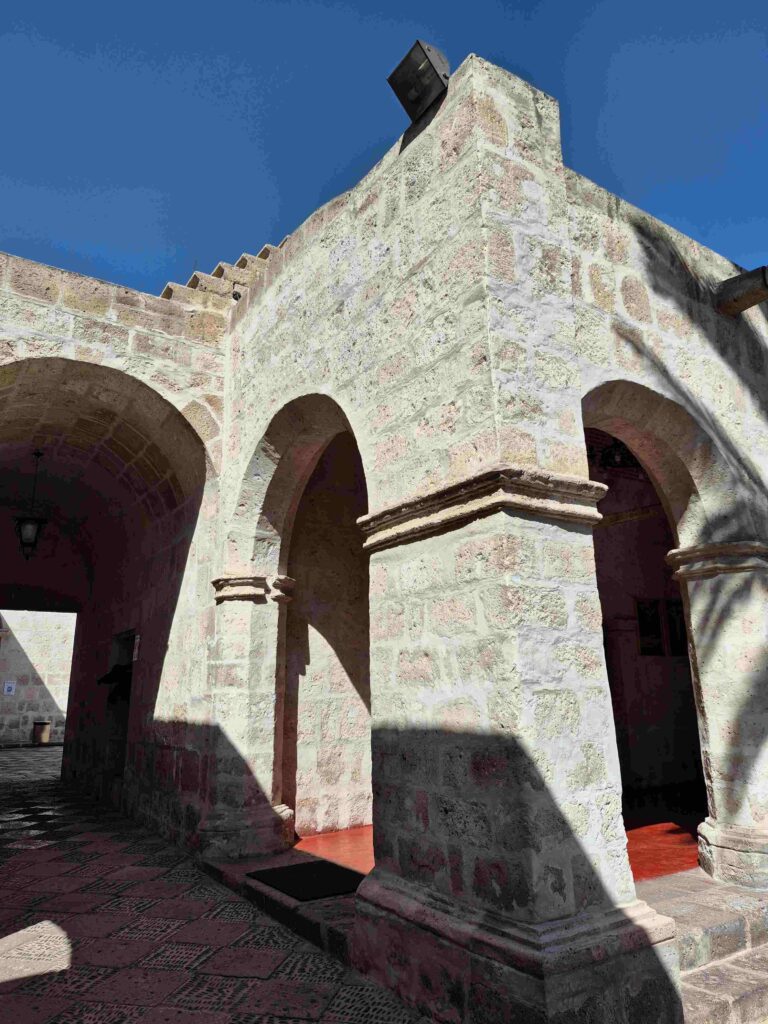
Sillar, the material that gives Arequipa its nickname, “La Ciudad Blanca” (The White City), is a type of white volcanic stone formed over two million years ago from eruptions from the volcanoes that left behind thick layers of compacted volcanic ash and rock, which eventually hardened into the porous, lightweight stone. While most commonly white, sillar can also appear in pink, gray, or yellow tones depending on its mineral content. Most of the buildings in Arequipa are white, but there are some stunning examples of the pink stone also. The Spaniards who built most of the old city were from Seville, Spain. Apparently, the stones reminded them of home, so they stayed.

The cathedral, completed in 1656, is white, sillar, and at night, the building is lit, bathing the remarkable stone walls and arches in a warm glow. After a stroll, we found a rooftop restaurant with decent food, mediocre wine and a lovely atmosphere. The highlight was Knox’s observation of the waxing moon, tipped on its back, as it should be so close to the equator. Our walk back to the hotel —about 30 minutes uphill— was tougher than the decent. We noticed the altitude for sure!

Day 1 Photos HERE.

Day 1: Arequipa, Peru, June 30, 2025 Read More »

DAYS 7-8: LIMA, PERU

September 7-8, 2024

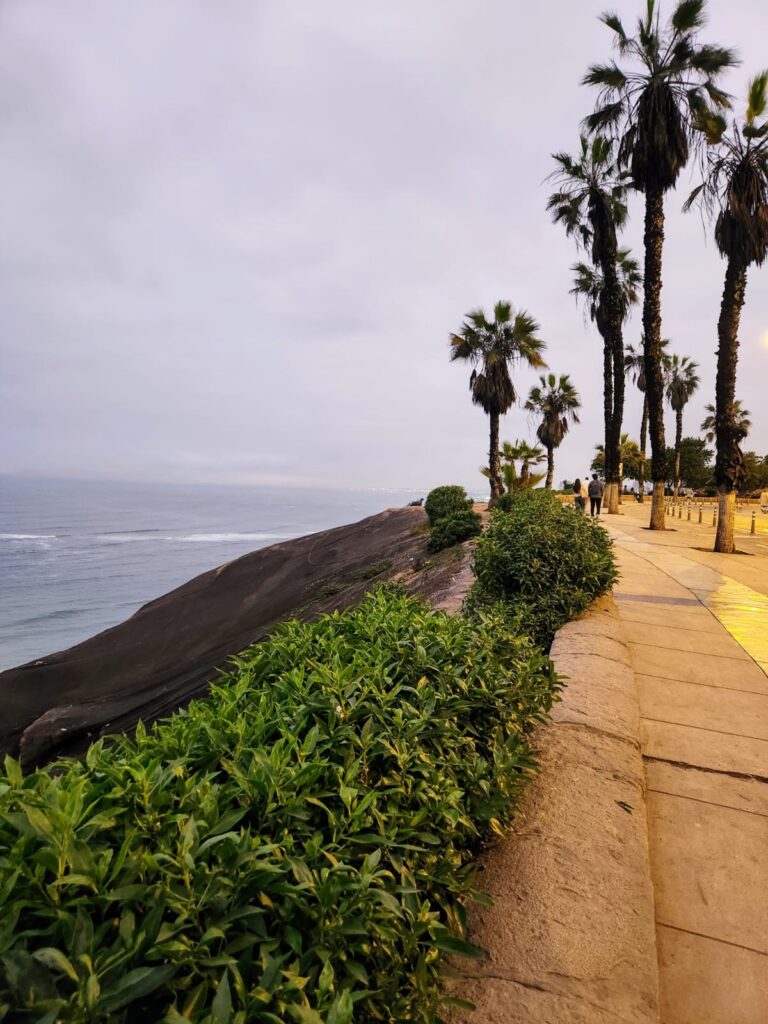
The following day, we walked north along the sea for an hour or so along beautifully maintained bike and walking paths reminiscent of bustling, active Central Park in New York City in the summertime. There were runners and cyclists, dogwalkers and tourists, all enjoying the temperate weather, and we took in the lovely scenery along the way, including the spring blooms of bougainvillea and tulips just beginning. Sushi was the objective (given our lack of seafood in Mendoza). 

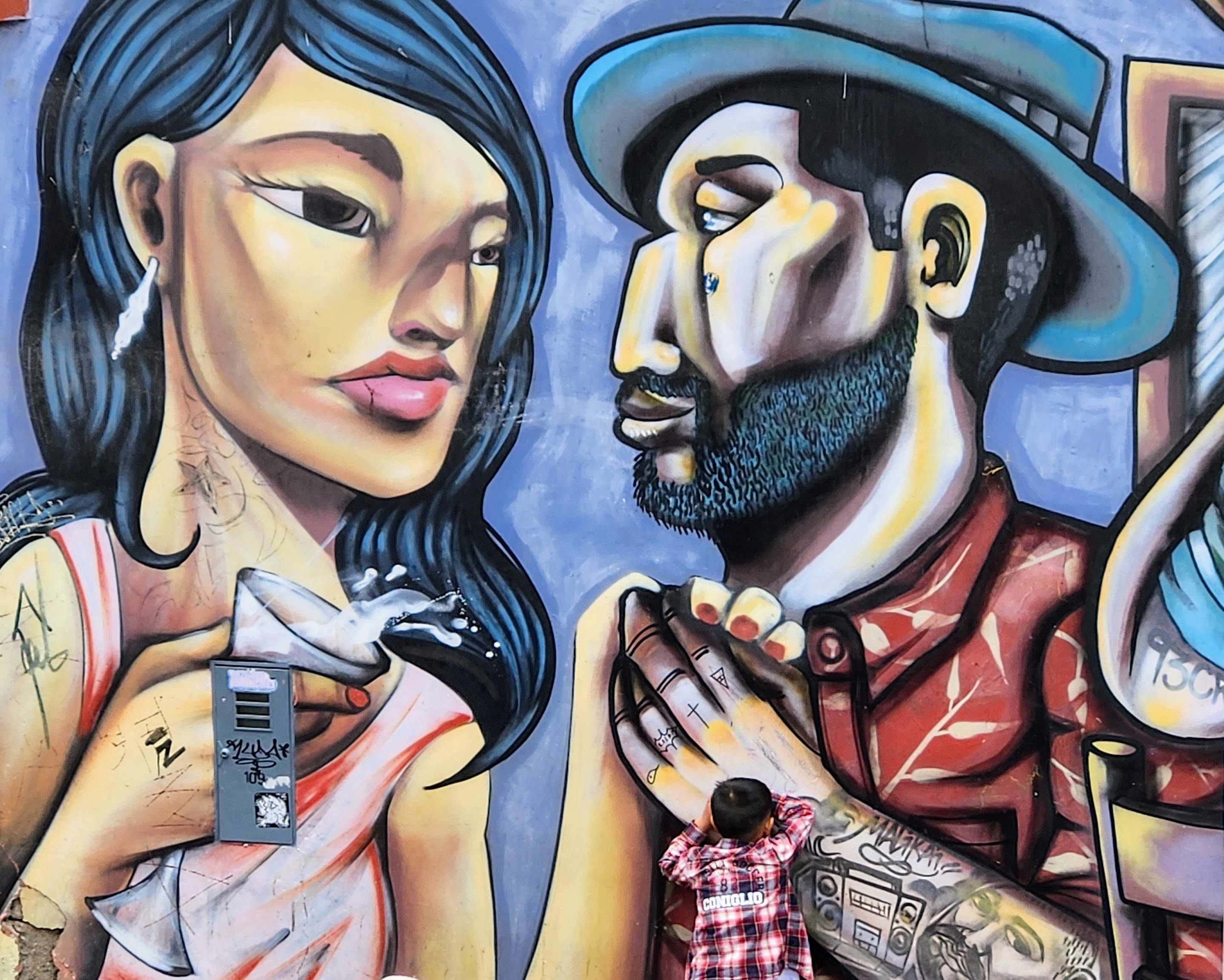
On our last full day in Lima, we decided to explore southern Barranco, a very artsy part of the district, with fabulous graffiti and galleries everywhere, cafes and brunch spots along narrow, cobblestoned streets lined with fashionable apartment buildings overlooking the ocean, interesting parks and museums, etc. Here, we were reminded of the Village in NYC: smaller, but it has the same vibe. At one gallery, an attendant asked if we had tried Asian/Peruvian cuisine and suggested we go to a nearby 100-year-old establishment (an institution!) for lunch. So, we found our way to Gran Chifa Chung Yion. We were the only tourists in the place on a Sunday. And the experience, sitting under the dragon on the wall, people watching and eating plentiful authentic, classic old-style Chinese accompanied by chicha morada with native Peruvians—what else can you ask for in a lunch?

Then we visited the fascinating  Museo Pedro de Osma, a beautiful old mansion turned private museum featuring art and antiquities from the Peruvian Colonial Period and an excellent exhibit detailing the Incan heritage of Lima and the surrounding areas. The residence was the family’s summer house until the 1940 Lima earthquake when Pedro de Osma’s children made Barranco their year-round home.

On the way back to the hotel, we found ourselves heading down a well-maintained stairway that deposited us below the cliffs on a bridge over the highway leading to the sea. We watched the surfers, couples, groups of young people, and (yes) break-dancers on the beach and then made the long climb back up to our hotel to finish packing. Before heading to the airport, we had dinner and drinks at Ayuhuasca Bar and Resto, a fabulous famous bar/restaurant recommended by friends.

Although we experienced only a tiny slice of Lima on this trip, mostly confining our days to within walking distance of our incomparable hotel, we loved the art, gastronomic culture and urban vibe and plan to return soon to learn more!

The link to the photos and videos for days 7 and 8 is here: Lima Days 7 and 8

DAYS 7-8: LIMA, PERU Read More »

DAYS 5-6: LIMA, PERU

September 5-6, 2024

We flew the short one-hour hop back to Lima in the afternoon and arrived at our hotel, Casa Republica, in the Barranco section, one of 43 districts in the city. On the way from the airport, the enormous palisades rising from the Pacific Ocean reminded us of Santa Monica, California.  Later, we learned that cliffs further south shield Barranco from colder and more humid winds, creating a warmer and drier microclimate than many of the other districts of Lima.

The garúa, or fog that blankets the coast of Peru, is a constant in Lima, resulting in a soft “greyness” permeated by the sun that persists through most of the winter months. We found it to be a welcome change from the dry, desert conditions we are used to in Mendoza. That evening, we walked along the esplanade above the ocean at dusk, which felt mesmerizing, with the waves breaking below and the glow of the city beyond. We continued a short distance to a nearby fish place, LA 73. So fresh and so good!!

On our first full day in Lima, we walked across the street to an art space and store called Dédalo and purchased several more textiles, jewelry and other items and afterward enjoyed a coffee and a bite to eat at their charming café in back. Next door, we found the Jade Rivera art gallery, an exhibit of the famous local artist’s work, a fascinating portfolio of street graffiti, more refined paintings and eclectic pieces. The MAC, Lima (Museum of Contemporary Art), a 15-minute walk from our hotel, offered more interesting Peruvian and South American artists’ work and the opportunity to view an exhibit and meet the artist Ramiro Llona.

Needing a bit of downtime that afternoon, we took it easy and, in the evening, we took an Uber to the San Isidro district to eat at Astrid y Gaston. The restaurant is housed in a beautiful old mansion (as are many hotels, art galleries and other businesses) with interior decoration aimed at luxury, fantasy and style. The bar, for example, is constructed around two beautiful native trees under festival-like streamers cascading from the ether in the middle of the central courtyard. We were seated in an adjacent courtyard for our tasting menu of “tapas”—eight courses plus dessert, which we enjoyed with a fine bottle of Chilean wine. Dishes included scallops in a cream, dill concoction, Peking duck tacos, a shrimp cocktail taco, river shrimp with blueberry sauce and yam shavings, pork bao with fruit orange sauce, pepper ice cream with nuts and a thin cracker crust on top and a chocolate souffle of 83% chocolate with ricotta garlic ice cream. Divine!

The link to the photos and videos for days 5 and 6 is here: Lima Days 5 and 6

DAYS 5-6: LIMA, PERU Read More »

DAY 4: CUSCO, PERU

September 4, 2024

Our tour guide, Dennis, arrived at the hotel at 7 am to collect us for our private, all-day tour of the Sacred Valley. After a 45-minute drive, we arrived in Chinchero, a small Peruvian town at 3760 meters (12,336 feet) featuring Incan ruins and colonial 17th-century structures built on top of the destroyed ancient walls. The district is the center of Peruvian weaving; several local, traditionally dressed women explained and demonstrated the intricacies of harvesting, dying and preparing llama wool for weaving. It turns out this demonstration is one of several sites connected to the Centro de Textiles Tradicionales del Cusco (CTTC), the museum we came across in Cusco. A little corny, but the beautiful artistry is quite impressive. We purchased several textiles from their enormous shop before continuing.

The next stop, another half hour further into the valley, was Moray, the ruins of an Incan agricultural testing laboratory at about 3400 meters (11,500 feet) above sea level. Moray comprises three crater-like depressions, each with several circular terraces of varying sizes and depths, with an integrated irrigation system believed to have been used to grow hundreds of varieties of crops, including corn, grains, and potatoes, in various conditions. The terraces descend about 150 meters (490 feet); each of the three circular structures has about 12 levels of terraces, and the largest has a diameter of about 182 meters (600 feet). Moray is also quite an engineering feat, built using intricate stone masonry dating back to the 13th century. Unbelievable!

Nearby, San Francisco de Maras, a town of about 50,000 people, is known for its ancient salt mines, which have been used since Incan times. We drove down several switchbacks into a valley below Maras to view thousands of “pozos,” or wells, placed in the form of terraces that stretch down the entire valley as far as one can see, occupying a total area of approximately 1.5 to 2 hectares (4 to 5 acres). Each pozo is formed with retaining walls of small stones sealed with natural clay mortar, forming dikes of approximately 5m2 (54 square feet). The valley of pozos is flooded with saltwater fed by a hypersaline underground spring that originated 110 million years ago during the formation of the Andes Mountains. The salt dries according to weather conditions and is harvested by the local owners and sold in Peru and presumably worldwide. When the Spanish invaded the surrounding communities and discovered the mines, the settlers developed thousands more, copying the existing antique pozos over the ensuing centuries. Ownership of each pozo has been passed down from generation to generation, and today, they are still mined by individual families. Once a year, they hold a salt festival called Kachi Raymi, a celebration of the harvest and a spiritual celebration of the natural world.

We ate lunch at a relatively touristy stop, but it was a relief to relax for an hour out of the hot sun. We enjoyed the local cuisine and cold, refreshing chicha morada.

Afterward, we drove about 40 minutes further into the Valley to Ollantaytambo, another important archeological Incan site from around the same period, when, in the 15th century, Pachacútec continued to transform his chiefdom into an Empire. Pachacutec rebuilt the town, which provided lodging for the Inca nobility, and his men farmed the terraces leading to the Temple at the top. 

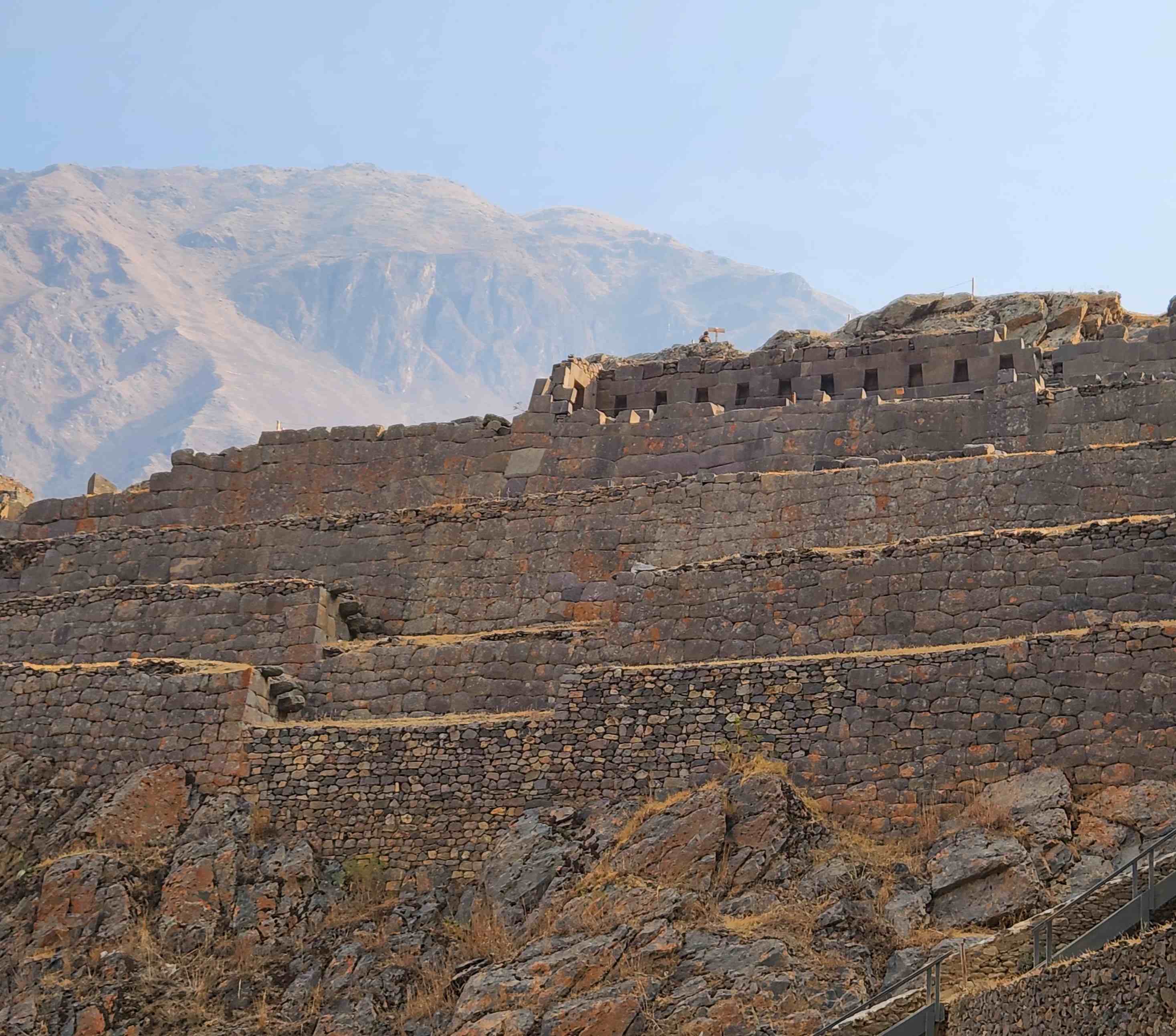
Today, Ollantaytambo is an Incan-colonial city at 2790 meters (9150 feet) that still maintains its layout and culture from the Incan period and its language, Quechua. It is a “dead” city, meaning few people still actually live there, and most of the houses have colonial architecture built by the Spanish on top of Incan ruins. But the ceremonial Temple of the Sun, made up of stone pieces that weigh as much as 100 tons atop a steep series of terraces, is more intact and a site to behold!

We spent several hours climbing to the top of the ruins, which was a challenging hike in altitude and very windy and dusty conditions; it was straight up! The walls are mainly intact throughout, including at least fifteen or more agricultural terrace levels, and it was easy to discern the apparent differences between the pre-Incan, lower fifth of each section, and the Incan structures built on top. Again, the precision of the Incan construction (perfectly positioned stones and identically sized windows, for example) was mind-boggling! From the unfinished Temple of the Sun at the top, we had a breathtaking view of the town below and the opposing mountain with its grain storehouses, called qullqas, built right into the top third of its cliff-like walls.  The Temple of the Sun featured massive slabs of stone, hauled up from miles away by hundreds of men, a feat that took decades, seemingly impossible, even by today’s construction standards.

Of course, the descent was again much easier than the accent, and we were content to nap on the 90-minute ride back to Cusco after a tour of an ancient place unlike anything we had ever seen. And there is so much more to see when we inevitably return!

The link to the photos and videos for day 4 is here: Cusco Day 4

DAY 4: CUSCO, PERU Read More »

DAY 3: CUSCO, PERU

September 3, 2024

This morning, we set out to visit Sacsayhuaman, an hour’s climb straight up from our hotel. Sacsayhuaman is an Incan ceremonial temple of worship (later referred to as a citadel by the Spaniards) on the city’s northern outskirts at 3700 meters (12,140 feet) and the most prominent structure built by the Incas in that period. We walked the first 30 minutes slowly up beautifully adorned streets filled with shops and artisans’ tables. On the way, we noticed pairs of ceramic bulls on top of some houses. We later learned that these are given by the parents of the bride and groom when couples construct new houses. The bulls serve as protectors for the new family home. The second 30 minutes were more difficult as we followed a very sunny, hot, extremely steep, winding, rocky path to the entrance gate of the site. A very tiring hike, but worth it for the beautiful views of the city!

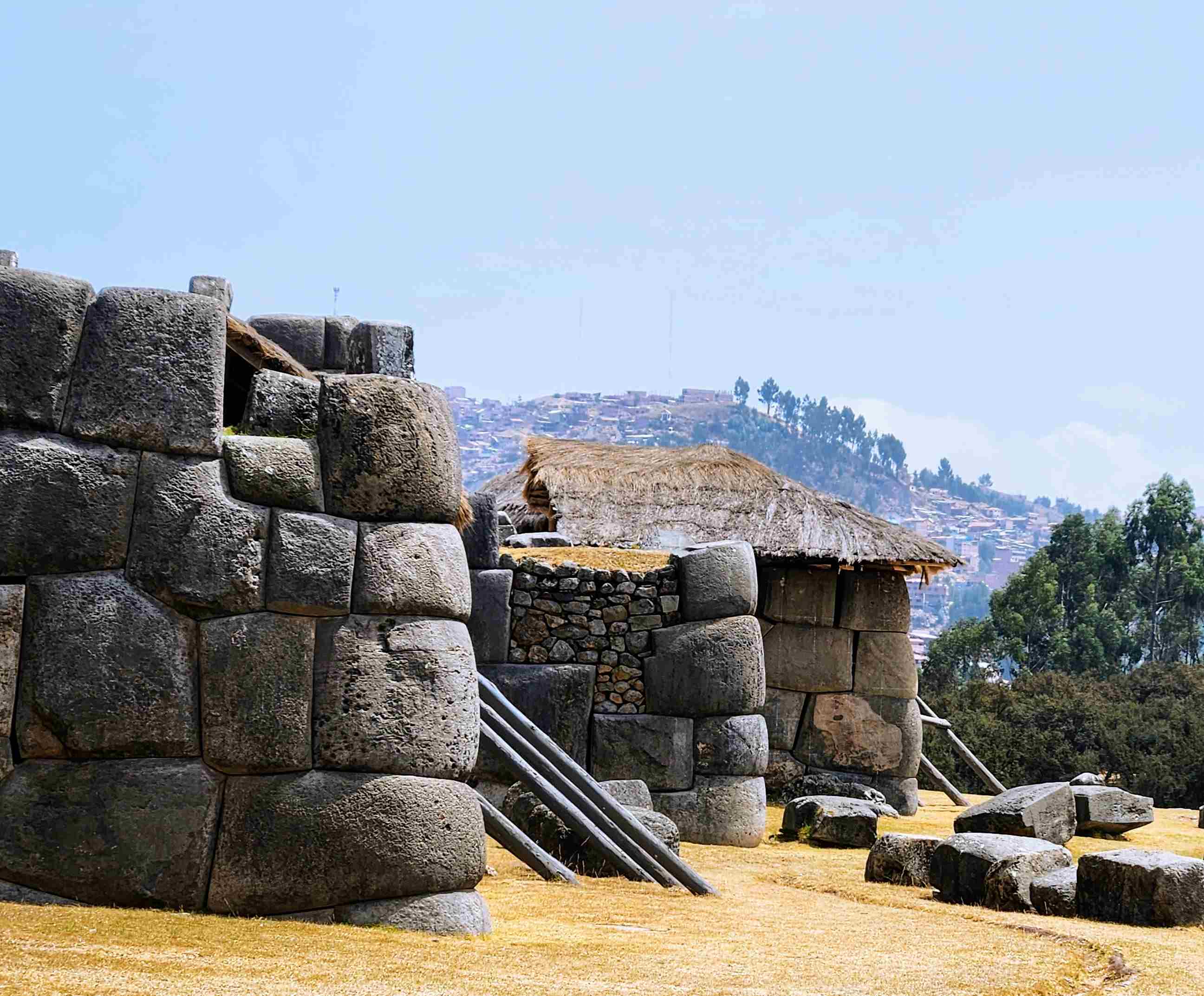
The site is enormous, almost twelve square miles encompassing several archeological sites, and much of the original massive stonework remains; huge, finely cut polygonal blocks, many over 4 meters in height, make up the walls of the fortress, and like at Qorikancha, the fine shaping of the stones was so precise that mortar was not necessary. However, here, the rocks varied in size and shape and still somehow fit together perfectly, whereas, at the latter, all the stones were cut in precisely the same size and shape. Incredibly, at both sites, the Incas used bronze bars and interlocking cutouts to secure the stones, which rendered them largely earthquake-proof; five hundred years of earthquakes have done remarkably little damage to most Incan structures. The corner of each zigzag in the primary temple wall is anchored by a massive stone weighing between 90 and 125 tons. Archeological scholars estimate that over 20,000 people worked on the construction, and the stones were brought from as far as 20km away. The walls reveal various symbols of animals typical of the region, arranged or carved by the Incas, including serpents, pumas and falcons (I’ve outlined a falcon in one of the photos). In addition, there are ruins of residences and towers, sanctuaries, warehouses, and aqueducts. In 1536, during the Spanish conquest, a significant battle occurred at Sacsayhuaman between Incan and Spanish forces. The Incas caused considerable damage to the Spanish but were ultimately defeated, and unfortunately, many of the structures were destroyed.

Sacsayhuaman was an important temple where the Incan Festival of the Sun was held every winter solstice, in which offerings and sacrifices were likely made to honor the sun god. Today, a reenactment of the ceremony is still held each year. Only partially due to the altitude, the place is undoubtedly sacred and emits a mystical, spiritual feeling as you walk amongst the ruins and marvel at the architecture. Truly a remarkable site to see.

After the (much easier) decent, we ate a late lunch at a tiny trout ceviche place near our hotel. I have never had better ceviche (and we were in the mountains)! Then, after checking out the artsy San Blas square, we headed for a siesta and finished the day with dinner at another popular, nearby restaurant, Pachapapa.

The link to the photos and videos for day 3 is here: Cusco Day 3

DAY 3: CUSCO, PERU Read More »

DAYS 1 and 2: CUSCO, PERU

September 1-2, 2024

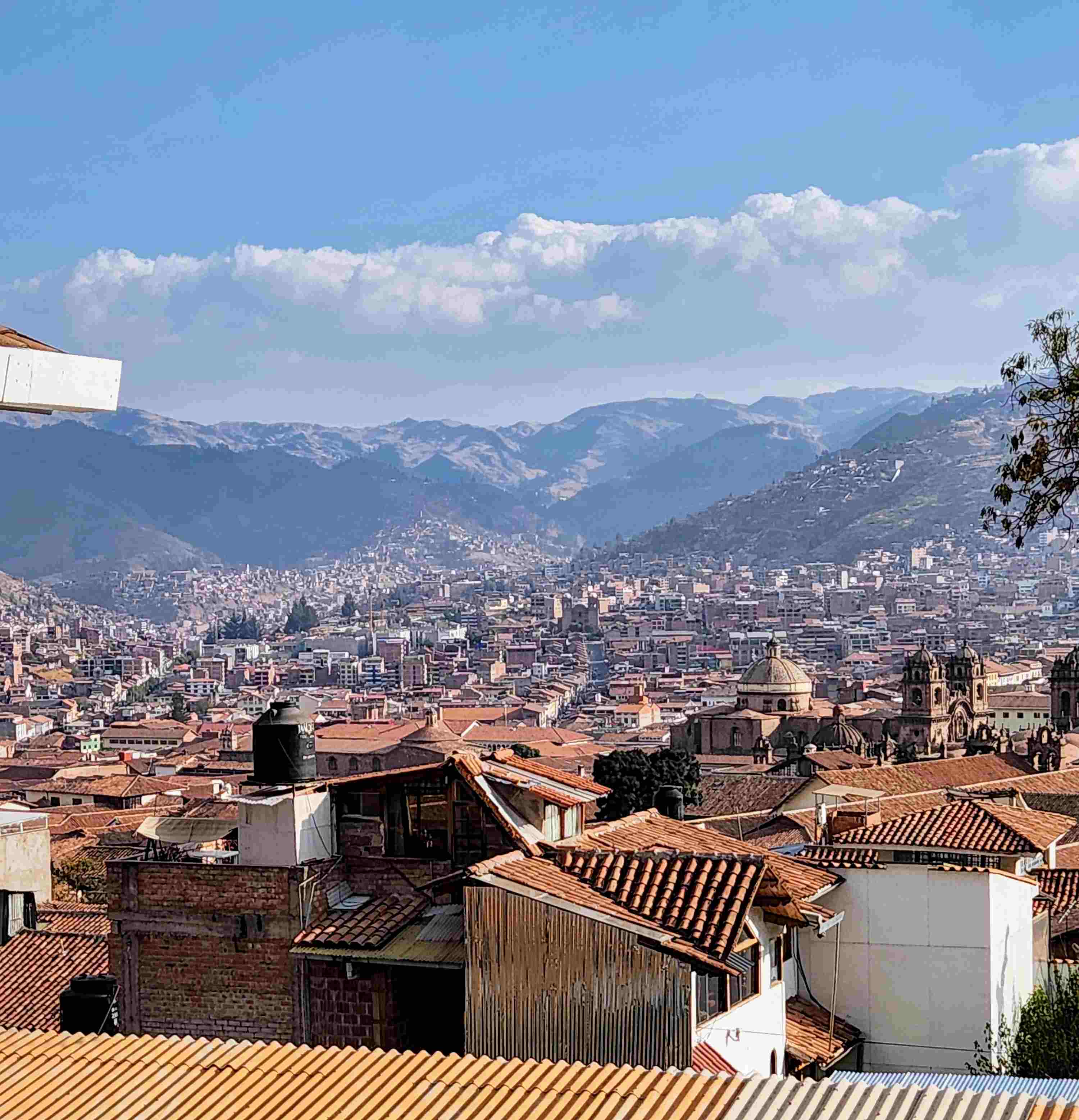
We flew directly from Mendoza to Lima and then caught a plane to Cusco. You fly into the city around the mountains and then into the valley below; it is quite a landing with a breathtaking view of the valley, revealing a city of half a million people.

Our hotel, the Atoq San Blas, is a 20-room boutique hotel built into the mountainside, like most structures in Cusco. Our altitude was 3000 meters (9,800 feet), about two-thirds of the way to the very “top” of the city. After coca leaf tea to help with the altitude, we headed straight for a siesta. We began climbing the winding, narrow streets early in the evening to reach the Limbus Bar & Resto. It was relatively close to the hotel, but boy did we feel the altitude getting there! The cocktail/dinner spot was at the top of one of the city’s many hills with 180-degree views. And they served fabulous drinks for $3 US dollars apiece, plus ceviche and a fresh, grilled trout to die for!

After breakfast on our first day, we started for the center of the historic district, a steep downhill trek through cobblestone alleys, stairways and narrow roads. We stopped at several textile shops along the way and finally came to one of the significant ruins, the excavated canals of the Incas. And just beyond, we arrived at one of Cusco’s most important temple ruins, the sacred Incan Sun Palace, Qorikancha. We met a lovely woman offering a private tour, who explained the Incan construction methods, religious practices, and the structure’s fate after the Spanish arrived in the 16th century. Built by the 9th Incan Emperor, Pachakutiq, the walls were once covered in gold, and the courtyard was filled with gold statues, all stolen by the Spanish.

We next found the Artisanal Market, a bit of a disappointment full of the same sorts of products sold in Jujuy and the Atacama Desert—handmade goods, alpaca sweaters and other textiles, woven table runners, etc. Cusco, Peru, Jujuy (Argentina) and Atacama (Chile and Argentina) were all part of the Incan Empire, so, unsurprisingly, many of these markets look the same. Traditional weaving and other arts and crafts have existed for generations throughout the old Incan Empire.

On our way to lunch (climbing back up toward the hotel very slowly), we passed through the Plaza de Armas with its tourist shops and restaurants and evidence of colonial influence, with many Catholic churches and cathedrals. We also came across a few high-quality textile shops, including the Museum of Weaving. A nonprofit collaborative, the museum (Centro de Textiles Tradicionales del Cusco) includes excellent exhibits on weaving and the lifestyle of the people over generations. The adjacent store featured goods made by artisans from small towns all over Peru. 

The link to the photos and videos for days 1 and 2 is here: Cusco Days 1 and 2

DAYS 1 and 2: CUSCO, PERU Read More »

Drive to Iruya, Salta

The thermometer in the car read around 5 degrees Celsius as we set out a little after 10 am. It was a clear day, and the mountains to the north were luminous in the rising sun as we drove north about 45 kilometers past Humahuaca and turned onto a dirt road for the rest of the trip to Iruya, another 50k, which took another hour and 40 minutes. We had read about this fantastic route, despite the roads, but we were underwhelmed for a good while — just a simple, dirt road cutting through sheep pastures and every 10 kilometers or so, a tiny town would appear. The most interesting thing was that every pueblo had a beautiful cemetery with flowers and a well-kept stone fence, and each seemed to be much larger than we would expect for the size of the towns.

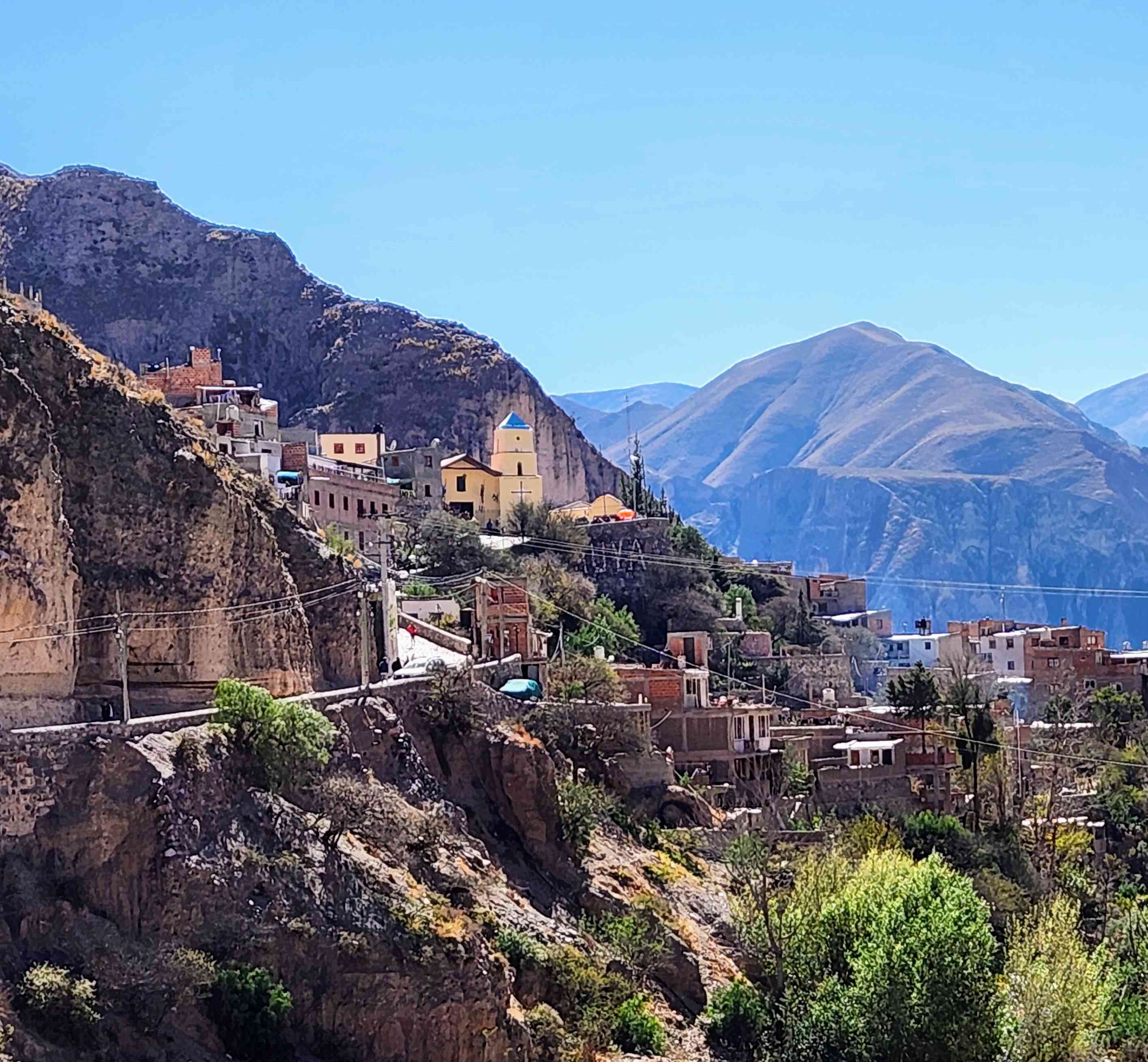
Finally, after about an hour we started climbing on switchbacks up to about 4000 meters (13,000+ft), passing through the Abra del Condor with spectacular views of pink, green, and purple mountains with clouds hanging in between them and the wide, rocky fields of yellow grass and paths below us. Harrowing would be my descriptor of the route, but then I’m a bit afraid of heights (?!). We passed a sign informing us we had crossed from Jujuy to Salta and then with dozens of acres of farmland in the distance below, we headed down more switchbacks to about 2500m (8000ft) — a drop of 1500m (5000ft) –and then back up more winding roads along the canyon and up to Iruya, a village of maybe a 1000 people built into the cliffs at 2800 meters altitude and above the river. Along the way we encountered several mules loose on the side of the road who stopped to say hello, and several interesting and amusing signs and sites, including the shrine of the “Immaculate Virgin de Buenos Caminos” (Immaculate Virgin of Good Roads) where all the road equipment for repairing the roads was parked. And we ran into an extreme cycling tour group, coasting down the switchbacks on what we presumed to be electric bikes.

Driving through the town of Iruya is impossible because of the narrow streets, so we were directed to park in the riverbed below the town and walk up. In 6-degree crisp, cold weather, we hiked up to the church and then another kilometer to the top of the town and had a small lunch at the Iruya Hotel.

The return trip was just as hairy, but much quicker by at least 45 minutes probably due to Knox’s familiarity with the roads; we had more fantastic views coming the other way with the setting sun lighting up the mountains to the east. Without question, this road trip was one of the longest, most challenging dirt roads we have encountered ever, and worth every second!

Link to Photos:  https://photos.app.goo.gl/FbNdNTon2bUjWT8T6

Drive to Iruya, Salta Read More »

Scroll to Top