DAY 2: Arequipa, Peru, July 1, 2025
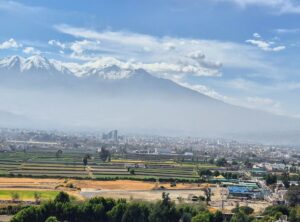
We began the day at Mirador de Carmen Alto with our guide. From the viewpoint, you can see how the city and valley fit together—the green terraces of the Chilina Valley below, still farmed after centuries, with the Río Chili running through them. Off in the distance, three volcanoes line the horizon: Chachani, the tallest at 19,872 feet, sits to the west and is often snow-capped. Misti, in the center, rises to 19,101 feet with its perfect cone and long history of eruptions. And Pichu Pichu, at 18,583 feet, stretches out like a man lying on his back with arms folded; locals point it out like an old friend. All three are considered sacred in the Andean tradition, honored as apus, or protective spirits.
Next, we headed to Mirador de Yanahuara in the Yanahuara district, a short drive from the historic center. It’s an expansive spot that offers sweeping views of the city and volcanoes through sillar stone arches. The area, along with nearby Cayma, has tree-lined residential streets and bustling commercial pockets.
In Quechua, “yana” means black, and “wara” means undergarment or loincloth. So this charming colonial district translates quite literally as “black underwear.” Historians trace the name to the Yanahuara people, Inca-era settlers relocated to the area, possibly referencing the color of their garments. One version of the story says that when women crossed the Río Chili, the dark volcanic silt stained their white undergarments, leaving them “yana wara.” Ha, ha!
The third viewpoint of the day was Mirador de Sachaca, where we climbed the five-story tower (it feels taller) for open views in every direction. From the top, the city stretches across the valley: green fields, scattered buildings, and the same three volcanoes in the distance, a little hazier now.
Arequipa’s nickname, El León del Sur, “The Lion of the South,” comes from its long history of doing things its own way, as our guide put it. In 1883, during the War of the Pacific when Lima was occupied, Arequipa became Peru’s provisional capital and even issued its own passports. People still joke about the “República Independiente de Arequipa,” and the pride locals have in their city is unmistakable. We saw it in everyone we met.
Next was Puente de Fierro, the 19th-century railway bridge that locals still like to claim was designed by Eiffel (it wasn’t, but the myth sticks). Built in 1871 as part of the line connecting Arequipa to Puno, it was engineered in the U.S. with then-cutting-edge iron trusses. It’s mostly pedestrian now. We walked across and looked down at the valley, where farmland stretches out below. Green chacras, small agricultural plots, still thrive in the middle of the sprawling city, with the Río Chili winding through it all, framed by the volcanoes above. (Same chacras, same meaning, as in our town’s name, Chacras de Coria.)
Mundo Alpaca was our last stop of the day. Envisioned by Frank W. Michell, a pioneer in Peru’s alpaca industry and the founder of Michell & Cia, the textile company behind the initiative, the Mundo Alpaca cultural center in Arequipa was established in 2005, building on Michell & Cia’s legacy that dates back to 1947, when the company opened Peru’s first alpaca combing and spinning plant.
I was skeptical because we’ve seen plenty of these displays across the Andes, but this one stood out. The layout is thoughtful, and the animals seem well cared for. The fiber sorting and weaving demos were familiar, but the museum surprised us: clear, detailed, and professionally done. It walks you through alpaca wool production, from raw fleece to finished yarn, with strong visual explanations. The unmistakable smell of alpaca wool hits you as soon as you walk in—warm, slightly earthy, and hanging in the air. The garments were exceptional, easily the best we’ve come across. I bought a sweater; Knox picked out some socks. Most of the company’s output is exported as yarn, but the boutique had some beautiful, finished pieces. Our guide finally clarified baby alpaca: it’s the very first shearing of a young alpaca, done only once, around age four.
After a late lunch of ceviche at the hotel (what else?) and a nap, we headed down the hill to the historic center in time for our reservation at Chicha to celebrate my birthday (we’d celebrated Knox’s in Lima the week before). With a bit of extra time, we stopped at Galería de Arte – Centro Cultural UNSA, tucked behind the Santa Catalina Monastery on a quiet stretch of Calle Ugarte. We didn’t expect much, just a quick pass-through, but the space opened into something more nuanced. It holds a rotating collection of contemporary Peruvian art, thoughtfully curated: bold pieces set in colonial rooms of white sillar, with high ceilings, arched doorways, and a soft-lit central courtyard. The galleries are compact but well arranged. Most works were contemporary: acrylics exploring light and color, along with striking oils and watercolors. We didn’t have time to see everything, so planned to return the next day and take our time.
Chicha por Gaston Acurio is a quiet space, low-lit, unassuming, and tucked into a restored building that doesn’t try too hard. We went with the fixed menu and wine pairings, which felt right for the occasion. It was my birthday (we’d celebrated Knox’s the week before in Lima), and the staff marked it with a song—first in English, then in Spanish. Not a surprise, but appreciated.
Two dishes stood out, both firsts for me. The cuy came shredded and seasoned, wrapped in a soft corn tortilla with a mild pepper sauce. (Cuy are essentially wild guinea pigs, considered a delicacy in Peru and now farmed for eating. We used to have tons of them in our yard at home until the dog drove them out.) The llama carpaccio was sliced thin and paired with something sharp, maybe citrus or mustard, that kept it from feeling heavy. The wines were from Argentina, Chile, and Peru, with an excellent Italian Sangiovese to finish.
After a long day, we took an Uber back to the hotel. We’d been debating whether to spend our last day on a trek outside the city but decided there was still more of Arequipa we wanted to explore. We figured the farther-afar spots like Colca Canyon, and the Salinas Salt Flats, could wait for another trip.
DAY 2 Photos HERE.