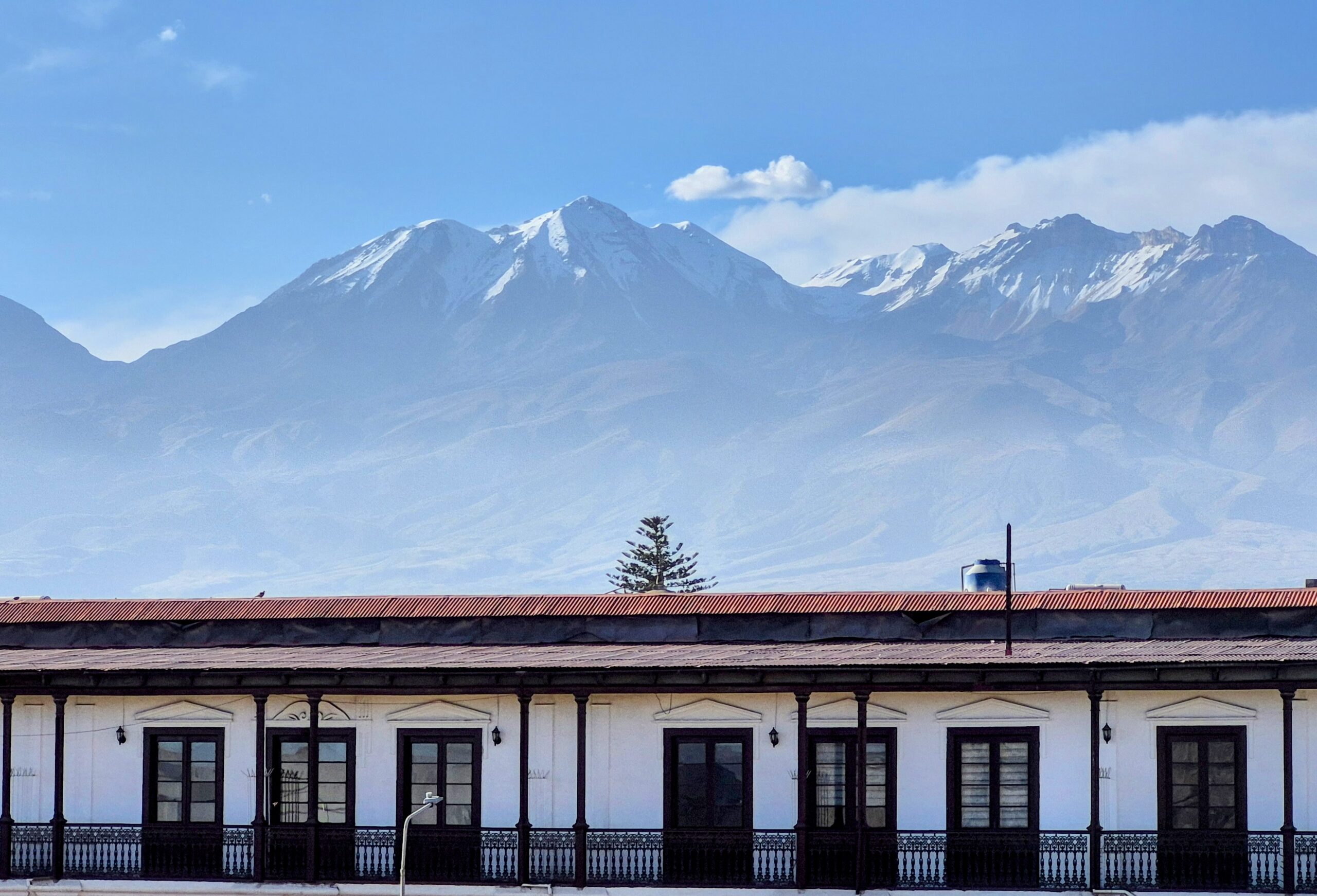
DAY 3: Arequipa, Peru, July 2, 2025
We decided to meet up with our guide again, this time to focus on the city itself rather than heading out to the surrounding sites. Plaza de Armas has been the heart of Arequipa since the 1540s, designed in the classic colonial grid layout. It remains lively today, with broad stone walkways, manicured gardens, and three arcaded sides enclosing the square. The Cathedral dominates the entire north end—just as striking by day as it is at night. In the sunlight, its white sillar stone looks crisp and pristine, but after dark, it glows with a soft pink hue. Unfortunately, we learned that seeing the inside of the cathedral is not possible, as it is closed to the public.
At the center of the plaza is a bronze fountain topped by a small figure called the “Tuturutu.” According to legend, he was a messenger left behind by the Inca to watch over a tambo and alert others to news using a horn; the name comes from the sound it made: tuturutúúú. Eventually, he was said to have frozen in place, horn in hand, facing the sun. But our guide offered another more modern version: the horn was used not for royal messages but to warn townspeople of pickpockets, minstrels, or other street action — a kind of early public service announcement from the plaza.
We crossed to the nearby Templo La Compañía de Jesús. The entire façade is densely covered with carved stone — vines, birds, angels —every inch used. Inside is quieter, with side altars along the walls and a large gold altar at the front. Our guide said the Jesuit church dates to the late 1500s but had been rebuilt after a major earthquake in 1687 and parts of it again restored after subsequent earthquakes.
The most striking part was the Capilla de San Ignacio, a side chapel with a painted dome and walls covered in bright, tropical murals picturing parrots, palm trees, monkeys…odd for a religious setting. The paintings are over 300 years old, have never been restored and are likely connected to Jesuit missions in the rainforest. Truly incredible.
From the historic center, we walked about ten minutes to reach Mercado San Camilo, Arequipa’s main market. The streets on the way were packed with cars bumper to bumper and vendors covering the sidewalks.
The market covers at least three or four city blocks. It is much like other markets we have visited in South America, but much bigger. Crowds moved through relatively wide aisles while vendors shouted prices and advertised their wares. There were stalls for corn, citrus, every sort of vegetable imaginable, stacks of corn, dried beans, coca leaves, dried medicinal herbs, mounds of freshly baked bread, cheeses, olives, etc. Our guide explained some of the regional produce, especially the unfamiliar varieties of potatoes and fruit, many of them grown in the surrounding valleys. Near the food stalls, rows of women sat shoulder to shoulder at small counters eating breakfast. Our guide said it’s common for women to come early to shop, then stay and catch up with friends over a meal.
The fish section was remarkable with long rows of counters stacked with large fish like corvina, mero, and bonito, all laid out on ice or being gutted on the spot. Also, our guide pointed out a big pile of what he said was caviar, known as Cau Cau, which is definitely fish eggs and something resembling caviar, though not the luxury sturgeon kind. Comng from Mendoza, where fresh fish isn’t common, the sheer volume and size of the fish on display was striking.
Upstairs in the textile section, it was quiet. A handful of vendors sat among stacked stalls of textiles and alpaca goods. From that upper level, we had a clear view of the floor below. From there, we could look down on the main floor and see just how large the market actually is.
Our guide then led us to explore several tambos, centuries-old communal buildings originally designed to house merchants, travelers, and their goods. These structures, dating back as far as the 17th and 18th centuries, are built from sillar, and today, many have been repurposed into regular apartments. One standout in our visit was Tambo de Bronce. Once a hub for commerce and later a military barracks during the War of the Pacific, it was restored after the 2001 earthquake and now serves as a cultural venue. With its stone façade, vaulted ceilings, and graceful arches, it stands as a clear example of Arequipa’s historic, enduring architecture.
Next, we headed to Museo Santuarios Andinos, home to Juanita, the frozen Inca maiden sacrificed over 500 years ago, but the wait for a tour (required) was too long, so we decided to save it for another day.
On the way back to the car, our guide stopped and invited us to check out a beautiful leather shop, Pedro P. Díaz Cueros, where we each picked out a classic wallet. Dating back to 1923, the shop specializes in high-quality leather goods. Really fine craftmanship. It was hard to choose!
We wanted to see some of the nicer neighborhoods in Arequipa because by this point, given the amazing weather, the people we had met, and the vibe of the city in general, we began seriously thinking this might be a perfect place to spend winters in the future. Our guide happily gave us a tour of two sections of the city, both within walking distance of the historic district: Cayma and Yanahuara.
We drove out of the center maybe ten minutes before hitting some traffic on the main commercial street of Yanahuara, quite lovely with a median full of pine trees and planted pots. We had been here the day before to see the city from the famous overlook. When you turn off the main drag into some of the quieter surrounding streets, you find beautiful townhouses and apartments with some houses sprinkled in, plus flower-filled balconies and quiet courtyards, with a blend of colonial architecture and modern style. Elegant, walkable, and full of character.
Cayma felt like a peaceful retreat, just outside the city center and close to the chacras and open farmland. We drove through quiet, residential neighborhoods higher up, with views of the city and a strong family-oriented vibe. Our guide lives there, and it’s easy to see why. Cayma offers a quiet, family-friendly atmosphere with lots of fresh air, wide streets, and scenic views, all while staying close enough to the city for convenience. You can walk to the historic center from there, but having a car would be more practical.
Our guide dropped us in the center mid-afternoon, where we wandered a bit, found a rooftop spot for a lovely late-day meal before heading back to the hotel.
Day 3 photos HERE.