Nov 15
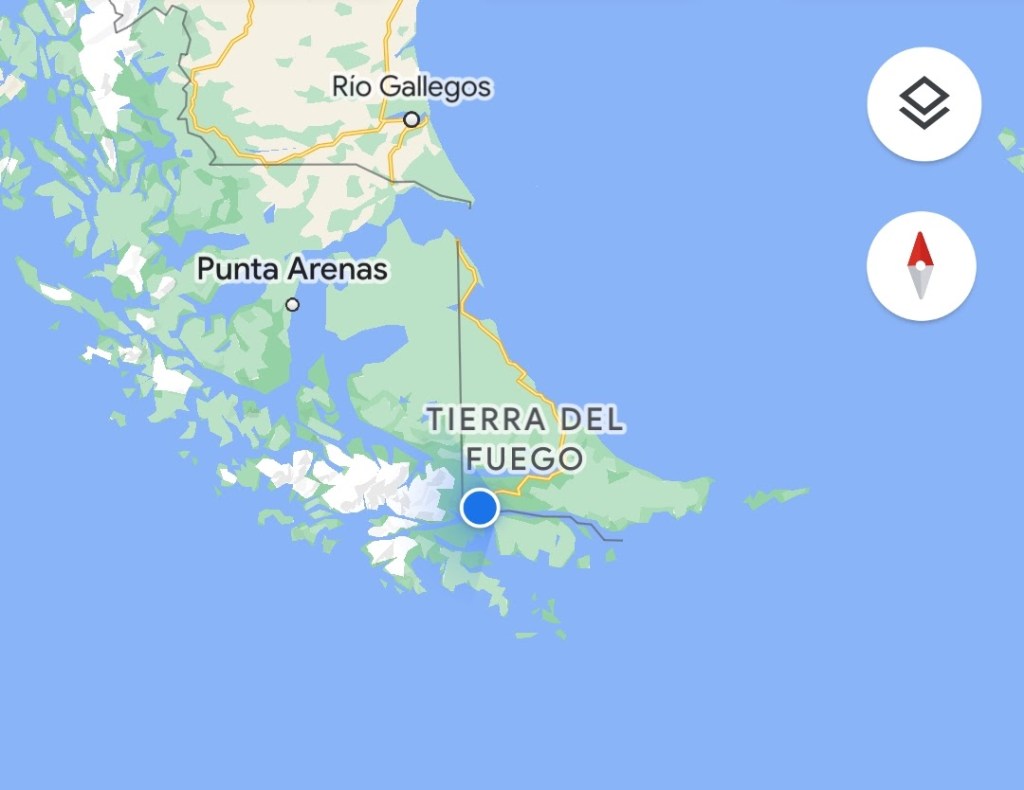
We had a late start; after coffee and breakfast and a gas stop, we were on the road by 11:30. The wind and the big sky continued under partly cloudy skies, and the temperature hovered around 8 degrees Celcius.
We drove south, following the ocean to our left, and again, the view was prairie, sand, and ocean, all three different shades of brown contrasted with the white clouds. Every other turn revealed more guanacos (the ranch fences are lower here, so they seemed, thankfully, to be safer), and the road was sometimes lined by strange, short, stubby trees that we guessed had been ravaged by high winds over time. As we turned inland, with even more prairie and rolling sandy hills, and meandering creeks in the valleys giving way to greener pastures, we glimpsed white peaks in the distance. Climbing up onto another high plain, we then began seeing many more stubby, dead, skeleton-like trees throughout the landscape with an eerie green coloring to them due to fuzzy, green algae. Perhaps a fungus? We later learned that it is a specific lichen that grows on the fragile trees throughout Tierra del Fuego and serves as an indicator of good air quality. If the air is bad, the lichen disappears. We descended into Tolhuin in a haze and fog that shrouded the snow-topped mountains ringing the small town, and overhead, an enormous cloud bank was blowing in, bringing snow flurries from the northwest. We stopped at an overlook beside the enormous Lake Fagnana to the west with 90 minutes to go; then we kept west, winding uphill again through the forested (trees the same as Calefate), steep Garibaldi Pass with flurries, and a view of the lake behind us. The 7 km back down winding switchbacks with good roads. and a marsh below us (beautiful red grasses, peat moss, and black pools of muddy water), then revealed a dusty blanket of recent snow on the trees on the mountainside. We passed a large ski area, Cerro Castor, named for the beaver but now a plague. We arrived in the city of Ushuaia, with a view of the Beagle Channel opening before us. It is a good-sized town of around 100,000 that stretches from the water and the seawall up under a large mountain, and is centered on a busy shipping port with several idle cruise ships docked. We arrived at Las Cauquenes Resort and Spa, a beautiful hotel past the main city up a hill overlooking the Channel. The first night went to La Kalma, a restaurant devoted to the food available in Tierra del Fuego; it was an incredible, sublime, experience, with fabulous pairings..really a treat. And, we walked around the city a bit as well. It feels like a mountain town, but you have the ocean on one side, so it is unique. Everyone we met was from somewhere else in Argentina or Chile so the population consists of transplants, some having been in Tierra del Fuego for years, and others recent or seasonal arrivals. A cab driver told us that many folks moved here in the 90’s because the government was trying to get folks down here (subsidies)? And it is a special place! We met numerous ambassadors making the case to us to move down here. Except for the year-round cold, we might. (??) On Thursday, we had a terrific guide for a day of trekking and canoeing in the National Parque of Tierra del Fuego. Due to my knees, we didn’t hike much, but it was enough to appreciate the grandeur and uniqueness of the forest and ecosystem in Ushuaia, the Beagle Channel, and Tierra del Fuego in general. We paddled in very windy conditions and partial sun along the shore of Lake Roca and down the outlet of the lake toward (and for a moment into) the Beagle Channel before coming ashore. In between, the team fed us a fabulous lamb stew for lunch in a large domo (dome) restaurant set up on the riverbank. We learned a tremendous amount about the history and ecosystem of Ushuaia and Tierra del Fuego, but I don’t want to bore you, so I’m including a few links of interest about the land and the indigenous peoples who lived here after the glaciers receded: – different trees (nothofagus)– lichen and fungus and hemi- parasitic plants- Calafate plant (this is the same lant we saw lining the roads in Chile earlier in the trip)– Yamani– green shoreline sedimentary rock and beaches and shell fossils in river from the sea– Treeline at 600 m in Tierra del Fuego…not height but due to temp.- beaver problem We also saw a lot of wildlife, some of which we have seen already in other parts of Patagonia, including:- a witch heron,- steamer duck (pato vapor)- Albatross– Skua (they steal penguin eggs)
THE PHOTO DUMP FOR THE RIO GRANDE TO USHUAIA LEG IS HERE:
Penguin Tour
We had a scheduled tour to Harberton Ranch and Martillo Island, where two species of penguins live and nest. In the pouring rain, we registered for the prebooked 7-hour tour of the Estancia, the island, and the history museum. The bus took 90 minutes to reach the dock, and after a short boat ride, we had ample time on the island, in a group of only 20 people (they allow no more at a time), to learn about and photograph the penguins. Two distinct species of penguins are currently nesting on the island, the Magallanes Penguins and the Gentoo Penguins. The former is smaller in stature and digs nests into the ground, has only the black and white coloring, and comes to the island only in the spring to mate and lay eggs. The latter is taller, nests on the beach without digging big holes, is distinguished by its orange beak and feet, and lives on the island year-round. We were very fortunate in two regards: although it was raining, we had calm conditions (the day before they had 50kph÷ winds); and, a third species, the King Penguin, was present on the island during our visit, and only one single individual (he has the yellow head coloring in the photos). Apparently, they are a young colony that has shown up a few seasons over the past years, and today this guy was scouting and considering the island as a place to bring his colony to nest. He hardly moved, standing tall among the others, the whole hour we were on the island.
We also had a tour of the island and of the very interesting whale museum there. The scientist who collected the enormous number of bones was Natalie Goodall. The history of the place is fascinating.
PHOTO/VIDEO LINK to the Penguins is here:
Las Cauquenes Resort and Spa: a relatively old but very well-maintained hotel at the top of a hill overlooking the Beagle Channel. Excellent restaurant, service, and very comfortable rooms. The spa is lovely and includes a pool and hot tubs overlooking the Channel. Again, we were in the clouds and rain for most of our stay, but we still had incredible views.


Leave a Reply